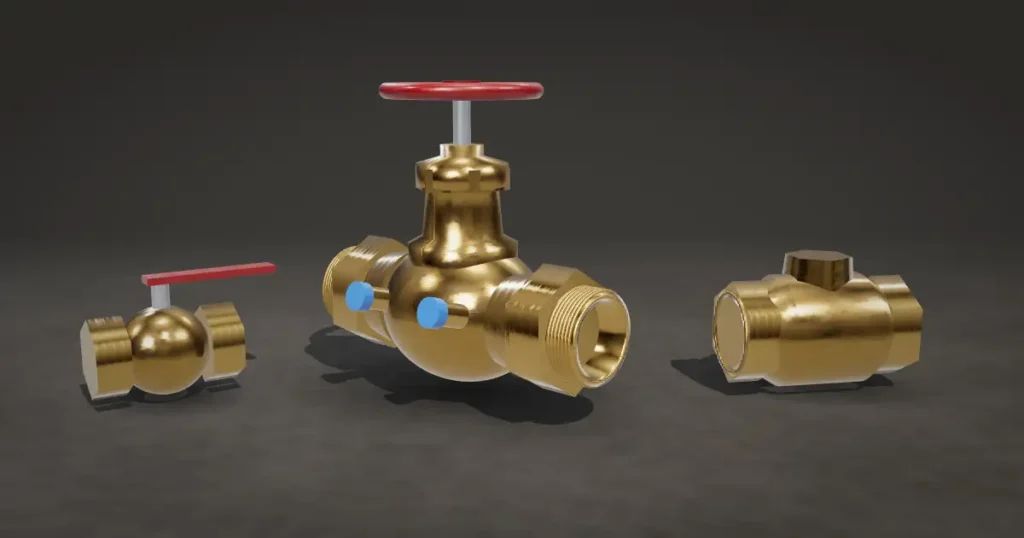
Open the valve schedule on almost any UAE building project and you will find three abbreviations again and again: DRV, PRV and NRV. They are all small brass or bronze valves, they often sit within a metre of each other, and they are easy to mix up on a material list. But they do completely different jobs. Understanding DRV vs PRV vs NRV helps you read drawings correctly, order the right valve, and avoid balancing, pressure and backflow problems after handover.
The Short Answer
| DRV | PRV | NRV | |
| Full name | Double regulating valve | Pressure reducing valve | Non return valve (check valve) |
| Controls | Flow rate | Downstream pressure | Flow direction |
| How it works | Manually set throttling position with a memory stop | Spring and diaphragm automatically reduce pressure to a set value | Opens with forward flow, closes automatically against reverse flow |
| Typical system | HVAC chilled water and heating circuits | Domestic water supply, high-rise buildings | Pump discharge, water supply, HVAC |
| Adjusted by | Commissioning engineer during balancing | Set at commissioning, checked periodically | No adjustment |
DRV: Double Regulating Valve
A double regulating valve is a balancing valve. In a chilled water system, water naturally takes the easiest path, so coils close to the pump get too much flow and coils at the far end of the building get too little. During commissioning, the balancing engineer adjusts DRVs on each branch and terminal unit until every coil receives its design flow.
The “double” refers to its two functions: it regulates (throttles) the flow, and it has a memory stop. Once the correct position is found, the stop is locked. Maintenance staff can then close the valve fully for isolation and reopen it to exactly the same balanced setting, without repeating the balancing work. Many DRVs also have pressure test points so the flow can be measured with a manometer.
Where you find it: chilled water and heating branches, fan coil units, AHU coils, and risers. See our brass DRV range, supplied from 1/2″ to 12″ for HVAC and chilled water balancing.
PRV: Pressure Reducing Valve
A pressure reducing valve lowers a high, variable inlet pressure to a steady, lower outlet pressure. Inside, a spring pushes against a diaphragm or piston. When downstream pressure rises above the set point, the valve throttles; when it falls, the valve opens. The outlet pressure is adjusted with a screw on top of the valve.
PRVs are essential in tall buildings. Booster pumps must create enough pressure to lift water to the top floors, which means the lower floors receive far more pressure than taps, mixers, water heaters and flush valves can safely handle. PRVs on each pressure zone or floor protect fixtures, reduce noise and splashing, and cut water wastage.
Where you find it: water supply mains, floor or zone branches in high-rise towers, and before equipment with a maximum inlet pressure. See our bronze PRV range from 1/2″ to 4″, with internal strainers, for high-rise and commercial buildings.
NRV: Non Return Valve
A non return valve, also called a check valve, lets water flow one way only. Forward flow pushes the disc or flap open; when flow stops or tries to reverse, the disc closes. It needs no operator and no adjustment.
NRVs stop water draining back through a pump when it stops, stop one pump back-feeding through another in a duty/standby set, and help prevent contaminated water flowing back into a supply line. Common designs include:
- Spring-loaded: a spring helps the disc close quickly, which reduces slam and water hammer and allows installation in more orientations.
- Swing: a hinged flap; low pressure loss, normally installed in horizontal lines.
- Lift: the disc lifts vertically off its seat; the valve must be installed in the orientation the manufacturer specifies.
Where you find it: pump discharge, water supply connections, tank inlets and HVAC circuits. See our cast bronze NRVs from 1/4″ to 6″ in spring-loaded, horizontal swing and vertical lift types, and our brass and bronze check valves.
How They Work Together
These valves are rarely installed alone. Two typical arrangements:
Fan Coil Unit Connection (Chilled Water)
Flow side: isolation ball valve, strainer, then the coil. Return side: control valve, DRV for balancing, then an isolation ball valve. The strainer protects the coil and control valve; the DRV sets the design flow.
PRV Station on a Water Supply
Isolation valve, strainer, pressure gauge, PRV, pressure gauge, isolation valve. Gauges on both sides let you check the set pressure. On critical supplies, a parallel bypass or duplicate PRV keeps water flowing during maintenance. An NRV is added where backflow must be prevented.
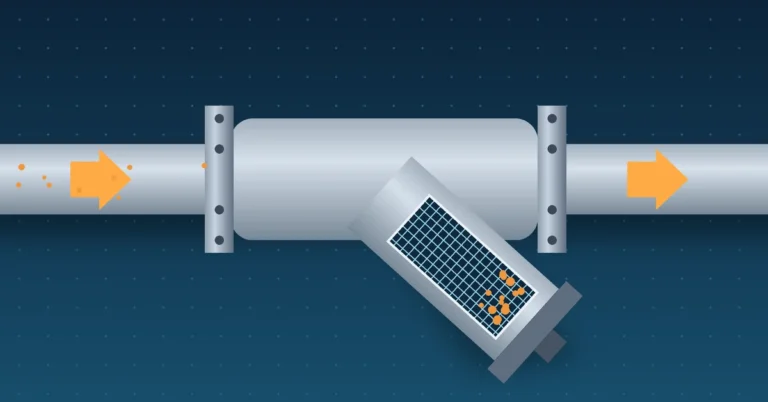
Dirt is the main enemy of all three valves, which is why strainers appear in both arrangements. Our Y-strainer guide covers mesh sizes and maintenance, and we supply brass and bronze Y-strainers and SS Y-strainers.
Common Mix-Ups to Avoid
- Using a DRV to reduce pressure. A DRV throttles flow at a fixed position; it does not hold a steady downstream pressure when inlet pressure changes. That is the PRV’s job.
- Using a ball valve to balance. Ball valves are for isolation. They are hard to set accurately part-open and have no memory stop.
- Installing an NRV against the arrow. Every NRV has a flow arrow on the body. Fitted backwards, it blocks the line completely.
- Skipping the strainer before a PRV. Debris on the seat stops the PRV closing tightly, and downstream pressure creeps up.
- Losing DRV settings. If the memory stop is not locked after balancing, the setting is lost the first time someone closes the valve.
What to Include When Ordering
- Valve type: DRV, PRV or NRV (and NRV design if specified)
- Size and end connection: threaded (BSP or NPT) or flanged
- Pressure rating, for example PN16 or PN25
- For PRVs: maximum inlet pressure and required outlet pressure
- For DRVs: design flow, if you need help choosing the size
- Body material (brass or bronze) and quantity
If you are pressure testing the installation before commissioning, our brass test plugs seal pipe openings temporarily during pressure tests. For a wider look at valve families, see our industrial valve selection guide.
Frequently Asked Questions
What is the difference between a DRV and a PRV?
A DRV is set by hand to a fixed opening to balance flow between circuits. A PRV adjusts itself automatically to keep the downstream pressure at a set value, whatever the inlet pressure does.
Is an NRV the same as a check valve?
Yes. Non return valve and check valve are two names for a valve that allows flow in one direction only.
Why is a DRV called “double regulating”?
Because it combines flow regulation with a memory stop, so it can be closed for isolation and reopened to the same balanced position.
Do I need a PRV in a villa?
It depends on the supply pressure and the booster pump setting. If pressure at the fixtures is higher than the fixtures are rated for, a PRV after the pump protects them. A plumber can measure the pressure and advise.
Get DRVs, PRVs and NRVs in Sharjah
Al Amaal Hardware supplies brass and bronze DRVs, PRVs and NRVs to MEP contractors and maintenance teams across the UAE.
Send us your valve schedule with types, sizes, connections and quantities, and we will confirm availability and pricing. Request a quote or message us on WhatsApp for a fast response.