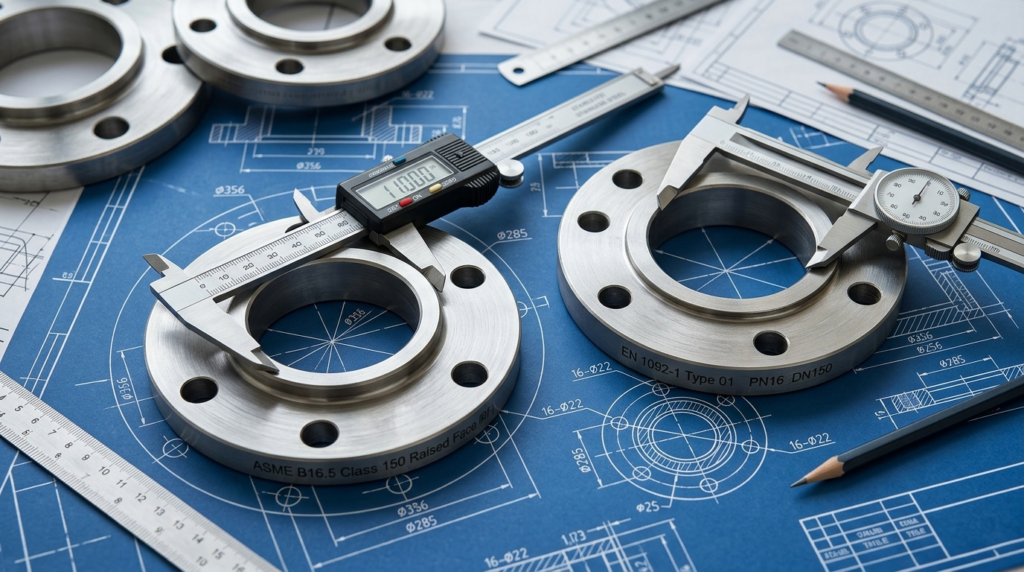
A flange is identified by its standard and pressure rating (for example ASME B16.5 Class 150 or EN 1092-1 PN16), its nominal size, and four measurements: outside diameter (OD), pitch circle diameter (PCD, also called the bolt circle), number of bolt holes and bolt hole diameter. Two flanges only bolt together if all four match. For example, a 4-inch ASME Class 150 flange has an OD of 230 mm, a PCD of 190.5 mm and 8 holes, while a DN100 PN16 flange has an OD of 220 mm, a PCD of 180 mm and 8 holes. Same pipe size, but they won’t fit together.
At our store in Sharjah’s Industrial Area 10, the most common flange problem we see isn’t quality, it’s fit. A contractor brings in a flange from site, or orders “4 inch flanges,” and the new flange doesn’t line up with the valve or pump already installed. This guide gives you the dimension tables we use every day for ASME B16.5 Class 150 and EN 1092-1 PN16 flanges, shows you how to measure an unknown flange, and explains exactly what to send us so your order fits first time.
How to Measure a Flange
You need a steel tape or vernier caliper. Measure these five things:
- Outside diameter (OD): across the full face of the flange, edge to edge.
- Pitch circle diameter (PCD): the diameter of the circle running through the centres of the bolt holes. For flanges with an even number of holes, measure from the centre of one hole to the centre of the hole directly opposite. A quicker way: measure from the left edge of one hole to the left edge of the opposite hole; that distance equals the PCD.
- Number of bolt holes: always a multiple of four on ASME B16.5 flanges.
- Bolt hole diameter: measure across one hole. On ASME B16.5 flanges the hole is 1/8 inch (3.2 mm) larger than the bolt.
- Bore and face type: the inside diameter (matched to the pipe schedule on weld neck flanges) and whether the face is raised face (RF), flat face (FF) or ring type joint (RTJ).
Then compare your OD, PCD and hole count with the tables below. If they match a row exactly, you’ve found your standard and size. If they’re close but not exact, you probably have the other standard.
ASME B16.5 Class 150 Flange Size Chart (mm)
These dimensions apply to all Class 150 flange types in ASME B16.5, including weld neck, slip-on, blind, socket weld, threaded and lap joint, because they share the same OD, bolt circle and drilling for a given size.
| NPS (inch) | DN | Flange OD (mm) | PCD / bolt circle (mm) | No. of bolts | Bolt size (inch) | Hole dia. (mm) |
|---|---|---|---|---|---|---|
| 1/2 | 15 | 90 | 60.3 | 4 | 1/2 | 15.9 |
| 3/4 | 20 | 100 | 69.9 | 4 | 1/2 | 15.9 |
| 1 | 25 | 110 | 79.4 | 4 | 1/2 | 15.9 |
| 1 1/4 | 32 | 115 | 88.9 | 4 | 1/2 | 15.9 |
| 1 1/2 | 40 | 125 | 98.4 | 4 | 1/2 | 15.9 |
| 2 | 50 | 150 | 120.7 | 4 | 5/8 | 19.1 |
| 2 1/2 | 65 | 180 | 139.7 | 4 | 5/8 | 19.1 |
| 3 | 80 | 190 | 152.4 | 4 | 5/8 | 19.1 |
| 4 | 100 | 230 | 190.5 | 8 | 5/8 | 19.1 |
| 5 | 125 | 255 | 215.9 | 8 | 3/4 | 22.2 |
| 6 | 150 | 280 | 241.3 | 8 | 3/4 | 22.2 |
| 8 | 200 | 345 | 298.5 | 8 | 3/4 | 22.2 |
| 10 | 250 | 405 | 362.0 | 12 | 7/8 | 25.4 |
| 12 | 300 | 485 | 431.8 | 12 | 7/8 | 25.4 |
| 14 | 350 | 535 | 476.3 | 12 | 1 | 28.6 |
| 16 | 400 | 595 | 539.8 | 16 | 1 | 28.6 |
| 18 | 450 | 635 | 577.9 | 16 | 1 1/8 | 31.8 |
| 20 | 500 | 700 | 635.0 | 20 | 1 1/8 | 31.8 |
| 24 | 600 | 815 | 749.3 | 20 | 1 1/4 | 34.9 |
Class 150 carbon steel (ASTM A105) flanges are rated at roughly 19.6 bar (285 psi) at ambient temperature, with the rating falling as temperature rises. Class 300 flanges of the same size are larger and heavier, with different drilling, so never mix the two.
EN 1092-1 PN16 Flange Size Chart (mm)
Many UAE water, HVAC and drainage projects specify European PN-rated flanges, often written as “BS EN 1092-1 PN16.” Values below are for PN16 plate (slip-on) flanges.
| DN | Pipe OD (mm) | Flange OD (mm) | PCD (mm) | No. of bolts | Bolt size | Hole dia. (mm) |
|---|---|---|---|---|---|---|
| 15 | 21.3 | 95 | 65 | 4 | M12 | 14 |
| 20 | 26.9 | 105 | 75 | 4 | M12 | 14 |
| 25 | 33.7 | 115 | 85 | 4 | M12 | 14 |
| 32 | 42.4 | 140 | 100 | 4 | M16 | 18 |
| 40 | 48.3 | 150 | 110 | 4 | M16 | 18 |
| 50 | 60.3 | 165 | 125 | 4 | M16 | 18 |
| 65 | 76.1 | 185 | 145 | 4* | M16 | 18 |
| 80 | 88.9 | 200 | 160 | 8 | M16 | 18 |
| 100 | 114.3 | 220 | 180 | 8 | M16 | 18 |
| 125 | 139.7 | 250 | 210 | 8 | M16 | 18 |
| 150 | 168.3 | 285 | 240 | 8 | M20 | 22 |
| 200 | 219.1 | 340 | 295 | 12 | M20 | 22 |
| 250 | 273.0 | 405 | 355 | 12 | M24 | 26 |
| 300 | 323.9 | 460 | 410 | 12 | M24 | 26 |
*DN65 PN16 flanges are supplied with either 4 or 8 bolt holes depending on the edition of the standard and the manufacturer. Always count the holes on the mating flange before ordering.
ASME vs PN: Why “Same Size” Flanges Don’t Fit
This is the mistake we see most often. The pipe size matches, so buyers assume the flanges will too.
| Size | Standard | OD (mm) | PCD (mm) | Bolts |
|---|---|---|---|---|
| 2″ / DN50 | ASME B16.5 Class 150 | 150 | 120.7 | 4 × 5/8″ |
| 2″ / DN50 | EN 1092-1 PN16 | 165 | 125 | 4 × M16 |
| 4″ / DN100 | ASME B16.5 Class 150 | 230 | 190.5 | 8 × 5/8″ |
| 4″ / DN100 | EN 1092-1 PN16 | 220 | 180 | 8 × M16 |
At DN50 the PCDs differ by only about 4 mm, close enough that someone may try to force the bolts through. Don’t. Mismatched drilling stresses the bolts and leaves the gasket unevenly compressed, which is a common cause of leaks at pressure testing. If you need to join an ASME flange to a PN flange, ask us about adapter options.
What to Send Us for a Flange Quote
To quote accurately and supply flanges that fit first time, send:
- Standard and rating: e.g. ASME B16.5 Class 150, Class 300, or EN 1092-1 PN10/PN16
- Size: NPS (inch) or DN
- Type: weld neck, slip-on, blind, threaded or socket weld
- Face: RF, FF or RTJ
- Bore / schedule for weld neck and socket weld flanges (e.g. SCH 40)
- Material: MS/carbon steel (e.g. ASTM A105) or stainless steel (SS304/SS316)
- Quantity, and whether you need mill test certificates
If you don’t know the standard, send a photo of the flange next to a tape measure showing the OD, PCD and hole count. We’ll identify it for you.
Need flanges in Sharjah or anywhere in the UAE? Browse our MS flanges and SS flanges, or send your specification on WhatsApp at +971 52 684 9954. Visit us at Industrial Area 10, Store 7, Sharjah.
For more on choosing the right flange, read pipe flange types explained, weld neck vs slip-on flanges, what blind flanges are used for and MS vs SS flanges. Avoid the most common ordering errors with 9 mistakes when buying steel fittings and flanges.
Frequently Asked Questions
What is PCD in a flange? PCD stands for pitch circle diameter: the diameter of the circle passing through the centres of the bolt holes. It’s also called the bolt circle diameter.
How do I measure flange size? Measure the outside diameter, the PCD, the number of bolt holes and the hole diameter, then match them to a dimension table for the correct standard and pressure class.
Are ASME Class 150 and PN16 flanges interchangeable? No. Their OD, PCD and bolt sizes differ, even for the same nominal pipe size.
Are ANSI B16.5 and ASME B16.5 the same? Yes. ANSI B16.5 is the older name for the same standard, so the dimensions are identical.
Do slip-on and weld neck flanges of the same class have the same drilling? Yes. Within ASME B16.5, all flange types of the same size and class share the same OD, bolt circle and bolt holes, so they bolt together.
How many bolts does a 6-inch Class 150 flange have? Eight bolts of 3/4 inch on a 241.3 mm bolt circle.
About Al Amaal Hardware
This guide was prepared by the sales and technical team at Al Amaal Hardware, a pipe fittings, flanges and valves supplier based in Industrial Area 10, Sharjah, serving contractors, MEP firms and maintenance teams across the UAE. We stock carbon steel, stainless steel, brass, MI and GI fittings and help customers match flanges and fittings to their specified material, size and connection type.
Dimensions are for reference. Always confirm against the project specification and the current edition of the relevant standard before fabrication.
Related Guides and Products
- Types of pipe flanges explained — choose the flange type before you check the dimensions
- Weld neck vs slip-on flanges — the two most commonly confused types
- Pipe schedule chart — weld neck flanges are bored to suit a specific pipe schedule
- Blind flanges guide — sealing and isolating a line
- MS flanges and SS flanges — stock in Class 150, Class 300 and PN ratings