Two pipes can be the same size and still be completely different pipes. A 4″ Schedule 40 and a 4″ Schedule 80 both measure 114.3 mm across the outside, bolt into the same flanges and look identical in a stack. One has a 6.02 mm wall, the other 8.56 mm. Order the wrong one and the bevels will not match at the weld, the bore will be wrong for the flow, or the line will not hold its design pressure. A pipe schedule chart is how you avoid that.
This guide explains what a pipe schedule is, gives wall thickness figures in millimetres for the sizes most used on UAE projects, clears up the confusion between SCH 40, STD, XS and XXS, and shows how to make sure the fittings you order match the pipe.
What Is a Pipe Schedule?
A pipe schedule is a number that tells you the wall thickness of a pipe. It is written as SCH or Sch followed by the number: SCH 40, SCH 80, SCH 160. The number itself carries no units. It is simply an index into a dimensional standard.
Two rules make the system work:
- For a given nominal pipe size, the outside diameter never changes. A 2″ pipe is 60.3 mm OD whether it is SCH 10 or SCH 160. This is what lets the same flanges, supports and butt-weld fittings fit across schedules.
- As the schedule number rises, the wall gets thicker and the bore gets smaller. The extra metal is taken from the inside, not added to the outside.
That second point catches people out on flow calculations. A 4″ SCH 80 line has a bore of about 97.2 mm against roughly 102.3 mm for SCH 40 — a 10% loss in cross-sectional area for the same nominal size.
The Standards Behind the Numbers
- ASME B36.10M covers welded and seamless wrought steel pipe — carbon steel and alloy steel. This is where SCH 10, 20, 30, 40, 60, 80, 100, 120, 140 and 160 come from, along with STD, XS and XXS.
- ASME B36.19M covers stainless steel pipe and uses an “S” suffix: 5S, 10S, 40S and 80S.
Nominal pipe size (NPS) is the inch designation; DN is the metric equivalent. Neither is a measurement. A 2″ pipe has no dimension that is actually 2 inches — the OD is 2.375″ (60.3 mm) and the bore depends on the schedule.
Pipe Schedule Chart: Wall Thickness in mm
Wall thickness in millimetres for carbon and alloy steel pipe to ASME B36.10M, covering the sizes most commonly ordered for MEP, fire fighting, chilled water and general industrial work in the UAE.
| NPS | DN | OD (mm) | SCH 10 | SCH 40 | SCH 80 | SCH 160 | XXS |
| 1/2″ | 15 | 21.3 | 2.11 | 2.77 | 3.73 | 4.78 | 7.47 |
| 3/4″ | 20 | 26.7 | 2.11 | 2.87 | 3.91 | 5.56 | 7.82 |
| 1″ | 25 | 33.4 | 2.77 | 3.38 | 4.55 | 6.35 | 9.09 |
| 1-1/4″ | 32 | 42.2 | 2.77 | 3.56 | 4.85 | 6.35 | 9.70 |
| 1-1/2″ | 40 | 48.3 | 2.77 | 3.68 | 5.08 | 7.14 | 10.16 |
| 2″ | 50 | 60.3 | 2.77 | 3.91 | 5.54 | 8.74 | 11.07 |
| 3″ | 80 | 88.9 | 3.05 | 5.49 | 7.62 | 11.13 | 15.24 |
| 4″ | 100 | 114.3 | 3.05 | 6.02 | 8.56 | 13.49 | 17.12 |
| 6″ | 150 | 168.3 | 3.40 | 7.11 | 10.97 | 18.26 | 21.95 |
| 8″ | 200 | 219.1 | 3.76 | 8.18 | 12.70 | 23.01 | 22.23 |
| 10″ | 250 | 273.1 | 4.19 | 9.27 | 15.09 | 28.58 | 25.40 |
| 12″ | 300 | 323.9 | 4.57 | 10.31 | 17.48 | 33.32 | 25.40 |
Values are nominal wall thickness per ASME B36.10M. Mills are normally allowed a tolerance of −12.5% on wall thickness, so a 6.02 mm nominal wall can legitimately measure about 5.27 mm at its thinnest. Designers allow for this when they calculate the required thickness, which is why you should never specify a schedule by measuring an existing pipe with a vernier and rounding.
Working Out the Bore
Inside diameter = OD − (2 × wall thickness). For a 6″ line:
- SCH 40: 168.3 − (2 × 7.11) = 154.08 mm
- SCH 80: 168.3 − (2 × 10.97) = 146.36 mm
- SCH 160: 168.3 − (2 × 18.26) = 131.78 mm
STD, XS and XXS: Where They Match the Schedules and Where They Don’t
Before schedule numbers existed, pipe was sold as Standard (STD), Extra Strong (XS) and Double Extra Strong (XXS). Those names are still in daily use on UAE sites and in quotations, and they are a common source of ordering errors because they only line up with the schedule numbers in the smaller sizes.
| Designation | Where it matches a schedule | Where it stops matching |
| STD (Standard) | Identical to SCH 40 from NPS 1/8″ up to and including NPS 10″ | From NPS 12″ upward, STD is a fixed 9.53 mm (3/8″) — thinner than SCH 40 |
| XS (Extra Strong) | Identical to SCH 80 from NPS 1/8″ up to and including NPS 8″ | From NPS 10″ upward, XS is a fixed 12.70 mm (1/2″) — thinner than SCH 80 |
| XXS (Double Extra Strong) | A fixed wall for each size; not tied to any schedule number | Thicker than SCH 160 from NPS 1/8″ to 6″; from NPS 8″ up, SCH 160 is the thicker of the two |
Two practical consequences:
- At 12″ and above, “STD” and “SCH 40” are not interchangeable. A 12″ STD pipe has a 9.53 mm wall; 12″ SCH 40 has 10.31 mm. If a drawing says STD and the quotation says SCH 40, query it before the material is cut.
- At 8″ and above, XXS is not the heaviest option. An 8″ XXS wall is 22.23 mm while 8″ SCH 160 is 23.01 mm. Assuming “double extra strong” always means thickest is wrong above 6″.
SCH 40 vs SCH 80: Which Do You Actually Need?
| Consideration | SCH 40 | SCH 80 |
| Wall thickness | Standard wall | Roughly 40–50% thicker in common sizes |
| Pressure capability | Suits most building services and utility pressures | Higher working pressure for the same material and size |
| Bore and flow | Larger bore, lower pressure drop | Smaller bore; may need the next size up to keep velocity down |
| Weight and cost | Lighter, cheaper, easier to handle and support | Heavier per metre, higher material and freight cost |
| Welding | Faster, fewer passes | More weld passes, more consumables, more labour hours |
| Corrosion and erosion allowance | Limited spare metal | Extra wall acts as sacrificial thickness |
| Typical UAE use | Chilled water, fire fighting, compressed air, general utility and plumbing lines | High-pressure process lines, steam, pump discharge headers, erosive or sandy service, mechanically exposed runs |
SCH 80 is not simply “better”. Specifying it where the design does not call for it adds weight, cost, welding hours and support loading, and it shrinks the bore — which can quietly push velocity and pressure drop outside the design intent. On the other hand, choosing SCH 40 to save money on a line the consultant specified as SCH 80 is a rejection waiting to happen at inspection.
The schedule on a project comes from the piping specification, where it is derived from design pressure and temperature, the material’s allowable stress, a corrosion allowance and the mill tolerance. Treat the specification as the authority rather than a rule of thumb, and raise any query with the consultant before ordering.
Stainless Steel: The “S” Schedules
Stainless steel pipe is dimensioned to ASME B36.19M, which defines 5S, 10S, 40S and 80S. Because stainless has a higher allowable stress and costs considerably more, the standard offers thin-wall options that have no carbon steel equivalent — 5S and 10S are widely used for low-pressure water treatment, food and chemical lines.
In the smaller sizes, 40S and 80S carry the same wall thickness as SCH 40 and SCH 80 in B36.10M. In the larger sizes they diverge. Because the exact crossover point is a frequent source of argument on site, the safe practice is to quote the designation and the wall thickness together — for example “6” SCH 40S, 7.11 mm” — rather than relying on the schedule label alone. Note too that B36.10M schedules can also be supplied in stainless material, so “stainless pipe” does not automatically mean an S schedule.
For 304 and 316 pipework, our SS butt weld fittings and SS threaded fittings cover the common sizes, and our guide to carbon steel vs stainless steel pipe fittings explains where each material earns its cost in UAE conditions.
Matching Fittings to the Pipe Schedule
This is where schedule errors turn into site problems, and the rule differs by joint type.
Butt-Weld Fittings Are Ordered by Schedule
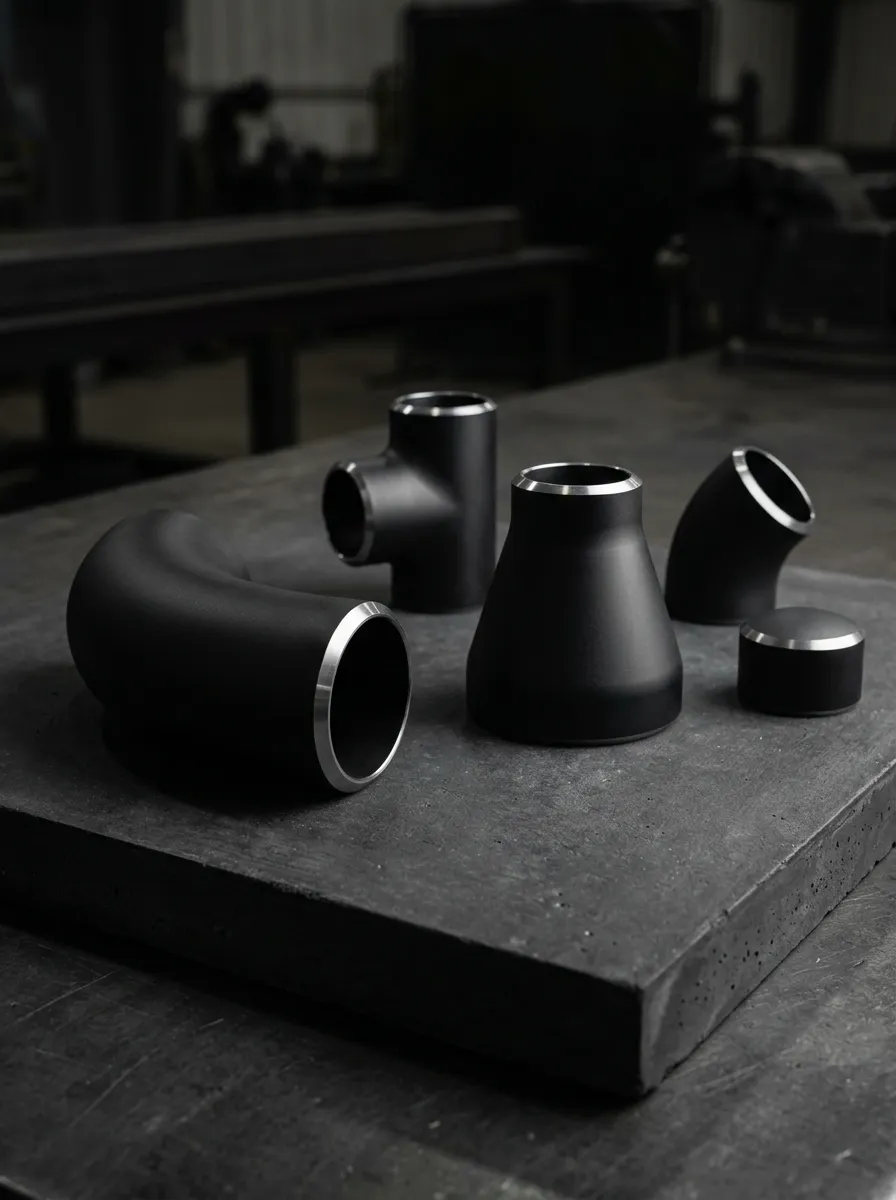
Butt-weld elbows, tees, reducers and caps to ASME B16.9 are made with the same wall thickness as the pipe they join. A 6″ SCH 40 elbow is bevelled to meet 6″ SCH 40 pipe. Weld a SCH 40 fitting to a SCH 80 pipe and the bores step at the joint: the root gap is uneven, the weld is likely to be rejected on radiography, and the mismatch creates a stress concentration and a turbulence point.
Always state the schedule when ordering butt-weld items. Browse our MS butt weld fittings for carbon steel lines, and see our guides to pipe elbow types and concentric vs eccentric reducers for the other details to confirm on the same enquiry.
Threaded and Socket-Weld Fittings Are Ordered by Class
Forged fittings to ASME B16.11 are not rated by schedule at all. They are rated by pressure class: 2000, 3000 and 6000 for threaded, and 3000, 6000 and 9000 for socket weld. Asking a supplier for a “SCH 80 threaded elbow” is a category error, although in practice it is usually understood to mean a class 3000 fitting intended for SCH 80 pipe.
Schedule still matters indirectly on threaded lines, because cutting a tapered thread removes wall. This is why threading thin-wall pipe is restricted — there is not enough metal left at the root of the thread. SCH 40 is generally the practical minimum for threading in carbon steel, and heavier schedules are used where pressure demands it. Our comparison of threaded vs butt-weld vs socket-weld fittings covers when each joint is appropriate, and the NPT vs BSP guide covers the thread standard itself.
For threaded work we stock MS threaded fittings and MI and GI threaded fittings, along with MS barrel nipples and MS swage nipples cut from the matching schedule.
Flanges Are Ordered by Class and Bore
Flanges are rated by pressure class — Class 150, 300 and upward, or PN ratings in the European system — not by schedule. Schedule becomes relevant for weld neck flanges, which have a bore machined to suit a specific pipe schedule. A weld neck flange bored for SCH 40 will not line up with SCH 80 pipe. Slip-on and blind flanges do not carry this constraint.
When you order weld neck flanges, give the class, the size and the schedule of the pipe. Our flange size chart covers the bolt dimensions, and we supply MS flanges and SS flanges across the common classes.
Where Schedule Does Not Apply
Not all pipe sold in the UAE is scheduled, and assuming otherwise causes confusion at the counter.
- GI pipe to BS 1387 is classified as Light, Medium or Heavy rather than by schedule. Medium class is the usual choice for plumbing and fire lines. See our GI pipe sizes and grades guide.
- Copper tube uses its own wall thickness tables under EN 1057 or ASTM B88 types K, L and M.
- PPR and other plastic pipe uses SDR or PN ratings. Our PPR vs GI pipe comparison covers where each belongs.
- Tube is not pipe. Tube is specified by actual outside diameter and wall thickness, with no NPS or schedule involved.
Ordering Checklist
- Nominal size (NPS or DN)
- Schedule, stated as a number where possible — and the wall thickness in mm alongside it for sizes 10″ and above, where STD and XS diverge from SCH 40 and SCH 80
- Material and grade, for example ASTM A106 Gr B pipe with ASTM A234 WPB fittings, or ASTM A312 TP316 with A403 WP316
- Seamless or welded (ERW), if the specification calls one out
- End preparation: bevelled, plain or threaded
- For fittings: schedule for butt weld, pressure class for threaded and socket weld
- Quantity, and any certification required such as mill test certificates to EN 10204 3.1
Common Mistakes to Avoid
- Treating STD and SCH 40 as interchangeable at 12″ and above. They are different walls and different weights.
- Assuming XXS is always the thickest. From 8″ upward, SCH 160 is heavier.
- Mixing schedules across a butt-welded joint, which produces a bore mismatch and a likely weld rejection.
- Forgetting the bore change when upgrading schedule. Moving a line from SCH 40 to SCH 80 for pressure reasons can push velocity and pressure drop out of specification.
- Specifying a schedule for threaded fittings instead of a pressure class.
- Ordering weld neck flanges without the schedule, which leaves the bore unspecified.
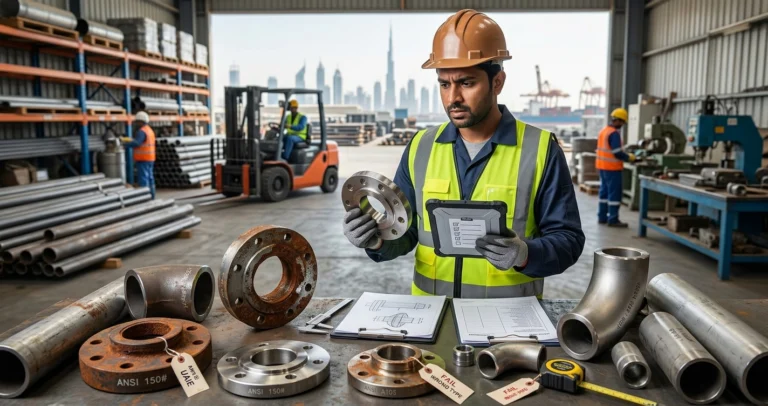
- Measuring an existing pipe to identify its schedule. Mill tolerance and corrosion both reduce the measured wall below nominal.
Frequently Asked Questions
What does pipe schedule mean?
Pipe schedule is a number that identifies the wall thickness of a pipe under ASME B36.10M for carbon and alloy steel, or ASME B36.19M for stainless steel. For any given nominal size the outside diameter stays the same; a higher schedule number means a thicker wall and a smaller bore.
What is the difference between SCH 40 and SCH 80 pipe?
They share the same outside diameter, but SCH 80 has a thicker wall and therefore a smaller bore, a higher pressure capability and more weight per metre. For 4″ pipe, SCH 40 has a 6.02 mm wall and SCH 80 has 8.56 mm, giving bores of roughly 102.3 mm and 97.2 mm respectively.
Is SCH 40 the same as STD?
Up to and including NPS 10″, yes — STD and SCH 40 have identical wall thickness. From NPS 12″ upward they differ: STD is a fixed 9.53 mm while SCH 40 continues to increase with size.
Is XS the same as SCH 80?
Up to and including NPS 8″, yes. From NPS 10″ upward, XS is a fixed 12.70 mm wall and is thinner than SCH 80 in those sizes.
Do pipe fittings have a schedule?
Butt-weld fittings do — they are made to match the schedule of the pipe so the bevels and bores align. Threaded and socket-weld fittings are rated by pressure class instead, and flanges are rated by pressure class, though weld neck flanges are bored to suit a particular schedule.
How do I calculate the inside diameter from the schedule?
Take the outside diameter for that nominal size and subtract twice the wall thickness. For 2″ SCH 40: 60.3 − (2 × 3.91) = 52.48 mm.
Which schedule is used for fire fighting pipework in the UAE?
SCH 40 carbon steel is the most common for wet and dry sprinkler and hydrant mains, with heavier schedules used where the design pressure or the authority having jurisdiction requires them. Always follow the approved project specification and the civil defence requirements for the emirate.
Sourcing Pipe and Fittings by Schedule in Sharjah
Al Amaal Hardware supplies pipe fittings, flanges and valves to contractors, MEP companies and fabricators across Sharjah, Dubai, Abu Dhabi and the wider UAE from our store in Industrial Area 10, Sharjah. We hold carbon steel, stainless steel, brass, MI and GI stock in the schedules and classes used on local projects, and we can cross-check your material list against the drawing before anything is cut.
If you are still deciding on materials and joint types, start with our complete pipe fittings buying guide. Otherwise send us your list with size, schedule or class, material and quantity — request a quote or message us on WhatsApp and we will confirm availability and pricing.