
Every piping system has to change direction, and the elbow is the fitting that does it. It is also one of the most ordered fittings on any UAE project, which is why small mistakes add up: a short radius elbow where the line needed a long radius, a 45° where the isometric shows a 90°, or a threaded elbow in a class that does not match the rest of the line. Understanding the main pipe elbow types takes the guesswork out of the order.
This guide covers elbow angles, long radius vs short radius, end connections, the standards behind them, materials for UAE conditions and exactly what to include in your enquiry.
What Is a Pipe Elbow?
A pipe elbow is a fitting installed between two lengths of pipe to change the direction of flow. Elbows are described by three things: the angle they turn through, the radius of the bend, and how they connect to the pipe. Get those three right and the elbow will fit the drawing; get one wrong and the spool will not line up.
Pipe Elbow Types by Angle
90° Elbow
The most common elbow. It turns the line through a right angle and is used everywhere from pump connections and risers to tight plant-room layouts. Because the change in direction is sharp, it creates more pressure loss than a gentler bend.
45° Elbow
A 45° elbow turns the line through half a right angle. It is used for offsets, for routing around obstructions and wherever a smoother change in direction is wanted. Two 45° elbows with a short length of pipe between them give a gentler 90° turn than a single elbow, which helps on drainage and slurry lines.
180° Return Bend
A return bend turns the flow back on itself. You will see it in heat exchanger coils, heater tubes and serpentine piping. Like 90° elbows, return bends come in long and short radius.
Non-Standard Angles
Where a layout needs an angle such as 22.5° or 60°, the usual answer is to cut a standard elbow down or to use a pipe bend made to the required angle. Specify this clearly on the drawing and in the enquiry so it is not mistaken for a standard part.
Long Radius vs Short Radius Elbows
For butt-weld elbows, radius is measured from the centre of the bend to the centreline of the pipe and is expressed as a multiple of the nominal pipe size (NPS).
- Long radius (LR): radius equal to 1.5 times the nominal size. A 4″ LR 90° elbow has a centre-to-end dimension of 6″ (152.4 mm).
- Short radius (SR): radius equal to the nominal size. A 4″ SR 90° elbow has a centre-to-end dimension of 4″ (101.6 mm).
| Feature | Long Radius (LR) | Short Radius (SR) |
| Bend radius | 1.5 × nominal size | 1.0 × nominal size |
| Pressure loss | Lower, smoother flow | Higher, more turbulence |
| Space needed | More | Less, suits tight layouts |
| Erosion and wear | Lower | Higher at the outer wall |
| Typical use | Default for process, HVAC, fire and utility lines | Congested plant rooms, skids and where space is limited |
Long radius is the default on most projects. Unless the drawing or specification says otherwise, an order for “90° elbows” in butt-weld is normally read as long radius. Short radius elbows are a deliberate choice for confined spaces and should be called out explicitly. In some services, such as low-pressure, high-velocity or erosive lines, designers may also restrict the use of short radius elbows, so check your project specification.
What About 3D and 5D Bends?
A 3D or 5D bend has a radius of three or five times the pipe diameter. These are pipe bends rather than standard elbows and are used where flow must be as smooth as possible, for example on pigged pipelines and some slurry or pneumatic conveying lines. They are made to order and need much more space than an elbow.
Elbow Types by End Connection
The elbow has to match the joining method used on the rest of the line. If that is still undecided, our comparison of threaded vs butt-weld vs socket-weld fittings explains the trade-offs.
Butt-Weld Elbows
Butt-weld elbows have bevelled ends that are welded directly to the pipe, giving a continuous bore and a permanent joint. They are the standard for larger sizes and higher-integrity services such as process, oil and gas, district cooling and fire mains. Wall thickness must match the pipe schedule so the bevels line up for welding — see our pipe schedule chart for SCH 40 and SCH 80 wall thicknesses.
Threaded Elbows
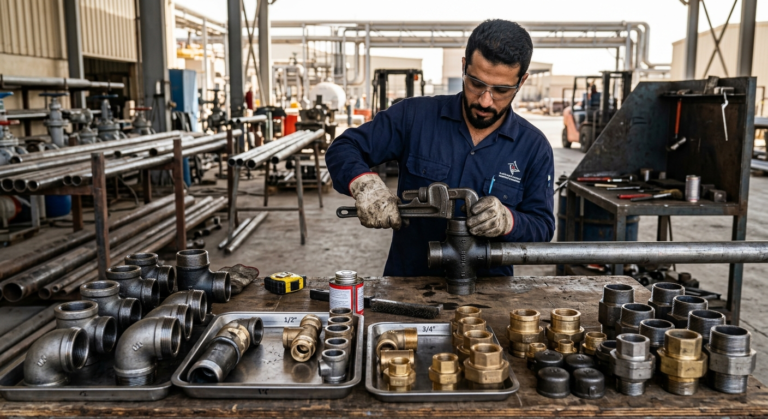
Threaded elbows have female threads on both ends and are assembled without welding. They suit small-bore plumbing, HVAC branches, compressed air and utility lines. Always confirm the thread standard, because NPT and BSP do not seal together; our NPT vs BSP guide shows how to tell them apart.
Socket-Weld Elbows
Socket-weld elbows have a recessed socket that the pipe slides into before a fillet weld is made around the outside. They are common on small-bore, higher-pressure lines where threaded joints are not allowed but full butt welding is impractical.
Street Elbows
A street elbow has a male thread on one end and a female thread on the other. It screws directly into another fitting without a nipple in between, which saves space and one joint in tight threaded layouts.
Reducing Elbows
A reducing elbow changes size and direction in a single fitting, saving a joint and some space. Where a separate size change is needed, see our guide to concentric vs eccentric reducers.
Standards to Know
| Elbow type | Common standard | Notes |
| Butt-weld LR and SR elbows, return bends | ASME B16.9 | Factory-made wrought butt-welding fittings; covers dimensions such as centre-to-end |
| Forged threaded and socket-weld elbows | ASME B16.11 | Pressure classes 2000, 3000 and 6000 for threaded; 3000, 6000 and 9000 for socket weld |
| Malleable iron threaded elbows | ASME B16.3 or EN 10242 | Common for GI and MI fittings in plumbing, HVAC and fire lines |
Material grades are specified separately from the dimensional standard, for example ASTM A234 WPB for carbon steel butt-weld elbows or ASTM A403 for stainless steel. If your specification names a grade, include it in the enquiry.
Choosing the Material for UAE Conditions
- Carbon (mild) steel: the standard choice for fire fighting, chilled water and general industrial lines, normally butt-welded and painted or coated.
- Stainless steel 304 and 316: for water treatment, desalination, food and coastal installations. 316 is preferred where chlorides and salt-laden air are present.
- Galvanised and malleable iron: widely used threaded elbows for plumbing, irrigation and fire sprinkler branches.
- Brass: small threaded elbows for water, HVAC and instrument connections.
Match the elbow material to the pipe. Mixing dissimilar metals in wet service invites galvanic corrosion at the joint, which is a real risk in the UAE’s humid coastal climate.
Ordering Checklist
- Angle: 90°, 45° or 180° return
- Radius: long radius or short radius (butt weld)
- Nominal size, and both sizes for a reducing elbow
- Schedule (butt weld) or pressure class (threaded and socket weld)
- End connection, and NPT or BSP for threaded elbows
- Material and grade
- Quantity and any certificate requirements, such as mill test certificates
Common Mistakes to Avoid
- Not stating the radius. If short radius is needed for space, say so; otherwise expect long radius.
- Mismatched schedules on butt-weld elbows, which leads to misaligned bevels and weld rejection. Check the pipe schedule chart before ordering.
- Using a short radius elbow directly at a pump inlet or in erosive service, where turbulence and wear are highest.
- Mixing thread standards on threaded elbows.
- Using a lower pressure class threaded elbow than the rest of the line.
Frequently Asked Questions
What are the main types of pipe elbows?
By angle, the main types are 90°, 45° and 180° return bends. By radius, butt-weld elbows are long radius or short radius. By connection, elbows are butt weld, socket weld or threaded, with street and reducing elbows as special variants.
What is the difference between a long radius and a short radius elbow?
A long radius elbow has a bend radius of 1.5 times the nominal pipe size, while a short radius elbow has a radius equal to the nominal size. Long radius gives lower pressure loss; short radius saves space.
Is a pipe elbow the same as a pipe bend?
Not quite. An elbow is a standard factory-made fitting with fixed dimensions. A bend is usually made from pipe to a larger, project-specific radius such as 3D or 5D.
When should I use two 45° elbows instead of one 90°?
Where a gentler change in direction helps flow or drainage, such as gravity drains and lines carrying solids, and where there is room for the longer layout.
What is a street elbow used for?
A street elbow has one male and one female end, so it screws straight into another fitting. It saves a nipple and a joint in compact threaded assemblies.
Sourcing Pipe Elbows in Sharjah
Al Amaal Hardware supplies elbows for contractors, MEP teams and fabricators across the UAE from our store in Industrial Area 10, Sharjah. For welded lines, see our MS butt weld fittings and SS butt weld fittings, which include long radius elbows. For threaded work, browse our MS threaded fittings, SS threaded fittings, MI and GI threaded fittings and brass threaded fittings.
Send us your list with angle, radius, size, schedule or class, material and quantity, and we will confirm availability and pricing. Request a quote or message us on WhatsApp for a fast response.