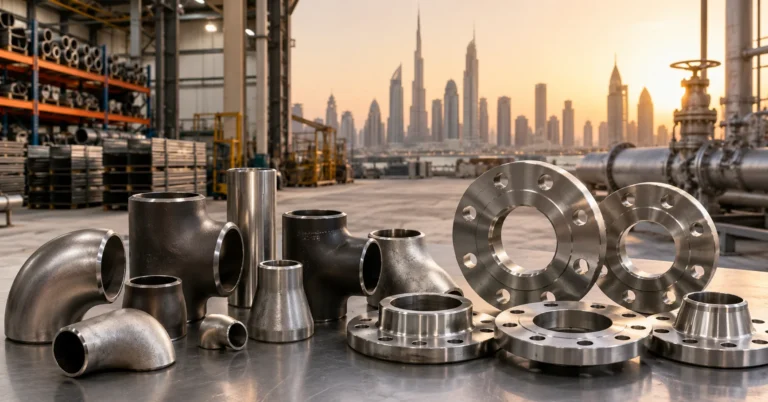
Every piping system changes size somewhere: at a pump, a control valve, a header branch or a meter run. The fitting that makes that change is a pipe reducer, and choosing between a concentric vs eccentric reducer is one of the most common decisions on UAE projects. Pick the wrong one and you can trap air at a pump suction, leave liquid pooling in a horizontal line, or throw off pipe support elevations across a rack.
This guide explains the main pipe reducer types, where each one belongs, the standards behind them, and exactly what to specify when you request a quote, so the fitting that arrives on site is the one your drawings call for.
What Is a Pipe Reducer?
A pipe reducer is a fitting that joins two pipes of different nominal sizes so flow can pass from one diameter to another. The same fitting is called an “increaser” when flow goes from the small end to the large end; the part itself is identical. Reducers are sized large end first, so a 4″ x 2″ reducer connects a 4-inch line to a 2-inch line.
Changing diameter changes velocity. Moving into a smaller pipe speeds the fluid up; moving into a larger pipe slows it down. A gradual taper keeps that transition smooth, which is why a proper reducer is preferred over improvised combinations of bushings and couplings on process and pump lines.
Types of Pipe Reducers
Concentric Reducer
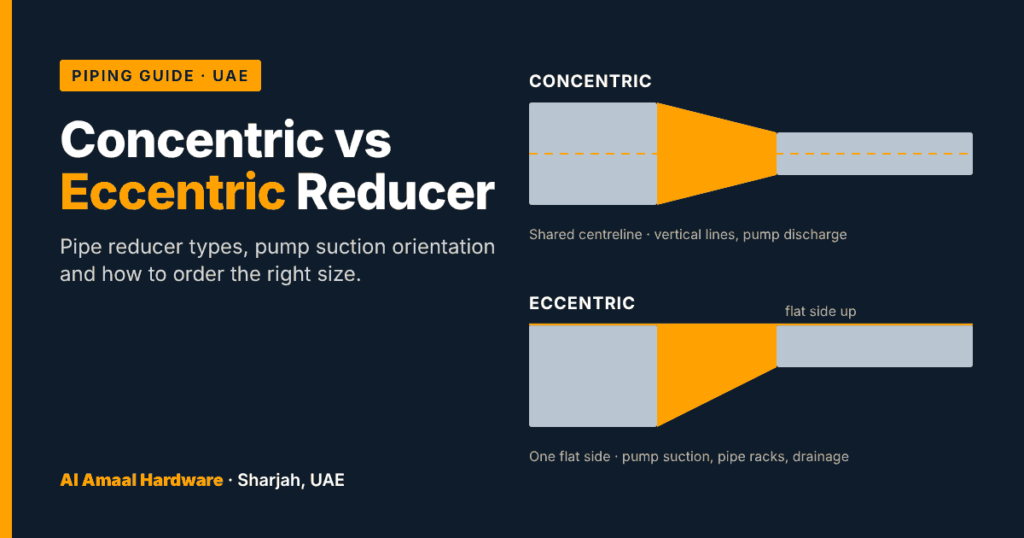
A concentric reducer is cone-shaped and symmetrical: both ends share the same centreline. Because the taper is even all round, flow stays centred and the change in velocity is gradual. Concentric reducers are the default choice for vertical pipework, pump discharge lines, and gas, air and steam lines where trapped liquid or air pockets are not a concern.
Eccentric Reducer
An eccentric reducer has one flat side, so the two ends are offset rather than sharing a centreline. That flat side can be installed on top (flat on top, often written FOT) or on the bottom (flat on bottom, FOB). The orientation is the whole point of the fitting: flat on top keeps the top of the pipe level so air cannot collect, while flat on bottom keeps the bottom of pipe level so liquid can drain and supports stay at one elevation.
Reducing Coupling (Reducing Socket)
A reducing coupling, also called a reducing socket, has female ends of two different sizes. It is the usual way to change size on threaded or socket-weld small-bore lines in plumbing, HVAC and utility piping. It is short and compact, but the step change in bore is more abrupt than a tapered reducer.
Reducing Bushing
A reducing bushing has a male thread on the outside and a smaller female thread on the inside. It screws into an existing fitting, such as a tee or valve port, to reduce the connection size. Bushings come in hex-head and flush styles. They are convenient for gauges, drains and instrument tappings, but on main flow lines a reducing coupling or reducer gives a smoother transition.
Swage Nipple
A swage nipple is a short, tapered reducing fitting made from pipe or bar, often used on higher-pressure small-bore lines. Like reducers, swage nipples come in concentric and eccentric versions, and each end can be plain, bevelled or threaded. That makes them useful for joining, for example, a welded header to a threaded instrument line. For more on short connectors, see our guide to pipe nipple types.
Reducing Tees, Elbows and Flanges
A size change can also be built into another fitting: a reducing tee has a smaller branch, a reducing elbow changes size while turning, and a reducing flange steps down at a flanged joint. These save a joint and some space, but they are specified per application rather than chosen as a general reducer.
Concentric vs Eccentric Reducer: Side-by-Side
| Feature | Concentric Reducer | Eccentric Reducer |
| Shape | Symmetrical cone, shared centreline | One flat side, offset centrelines |
| Typical orientation | Any; most common on vertical runs | Horizontal runs, flat on top or flat on bottom |
| Air pockets | Can trap air at the top of a horizontal liquid line | Flat on top lets air pass through |
| Drainage | Can leave liquid pooled in a horizontal line | Flat on bottom allows full drainage |
| Pipe rack supports | Bottom of pipe elevation changes | Flat on bottom keeps bottom of pipe level |
| Common uses | Pump discharge, vertical risers, gas, air and steam lines | Pump suction, pipe racks, condensate and drain lines |
When to Use an Eccentric Reducer
Pump Suction Lines
This is the classic application. Suction piping is often a size larger than the pump inlet, so a reducer sits right before the pump. On a horizontal suction line, an eccentric reducer installed flat side up stops air from collecting at the top of the fitting, where it could be drawn into the pump and contribute to cavitation, noise and loss of performance. Fire pump standards such as NFPA 20 also call for an eccentric reducer at the suction where pipe and pump flange sizes differ, installed so that air pockets are avoided. The correct orientation depends on how the suction line approaches the pump, so always follow the pump manufacturer’s instructions and the project drawings. Most HVAC pump sets also have a flexible connector next to the pump; our pump flexible connector guide covers where it goes and how to install it.
Pipe Racks and Sleepers
On long horizontal runs resting on racks or sleepers, an eccentric reducer installed flat side down keeps the bottom of the pipe at one elevation, so the line keeps sitting on its supports without shims or special shoes.
Drainage and Condensate
In horizontal liquid, condensate or slurry lines, flat side down lets the line drain completely instead of leaving a pocket of liquid behind the step. That matters for maintenance, freezing-sensitive services and steam systems where trapped condensate can cause water hammer.
When a Concentric Reducer Is the Better Choice
- Vertical pipework: air and liquid pockets are not an issue when the line runs up or down, so the symmetrical concentric reducer is simpler and keeps the line centred.
- Pump discharge: the line is full and under pressure, so a concentric reducer or increaser is usual on the discharge side.
- Gas, compressed air and steam headers: where there is no liquid to trap, concentric fittings give a balanced flow transition.
- Control valve and meter stations: designers often use concentric reducers either side of a valve or meter that is a size smaller than the line.
End Connections and Standards
The reducer has to match the joining method used on the rest of the line. If you are still deciding on that, our comparison of threaded vs butt-weld vs socket-weld fittings covers the trade-offs.
| Connection | Typical reducer type | Common standard |
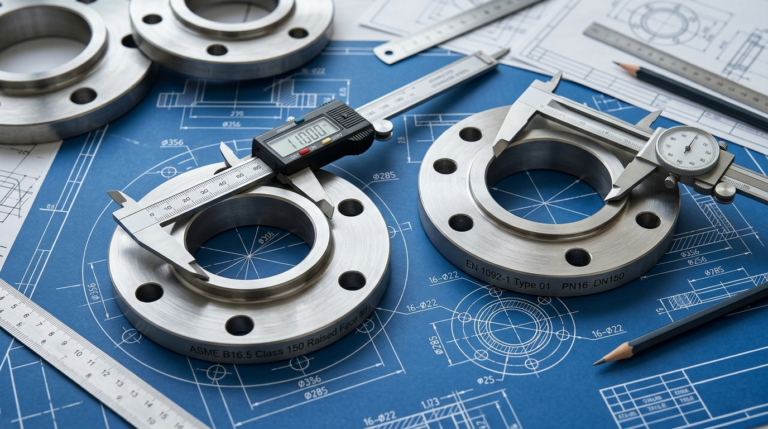
| Butt weld | Concentric and eccentric reducers | ASME B16.9 (factory-made wrought butt-welding fittings) |
| Socket weld and threaded (forged) | Reducing couplings, bushings | ASME B16.11 (forged fittings, socket-welding and threaded) |
| Swaged connections | Concentric and eccentric swage nipples | MSS SP-95 (swage nipples and bull plugs) |
| Malleable iron threaded | Reducing sockets, bushings | ASME B16.3 (malleable iron threaded fittings) |
On threaded reducers, also confirm the thread standard. Mixing NPT and BSP is a common source of leaks; our NPT vs BSP guide explains how to tell them apart.
How to Read Reducer Sizes and Schedules
- Size: written large end x small end in nominal pipe size, for example 6″ x 4″.
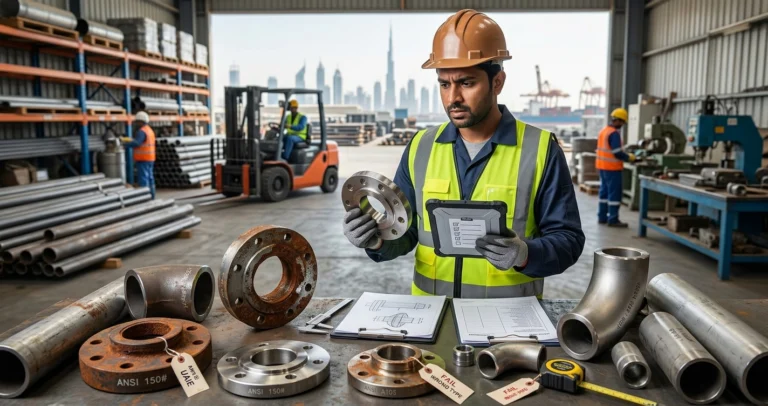
- Wall thickness: butt-weld reducers must match the schedule of each connecting pipe so the weld bevels line up. Where the two pipes have different schedules, state both, for example 6″ Sch 40 x 4″ Sch 80.
- Swage nipple ends: each end is described separately, using abbreviations such as BLE (bevelled large end), PSE (plain small end) or TSE (threaded small end).
- Eccentric orientation: the fitting is the same part either way up, but note FOT or FOB on isometrics so the installer fits it correctly.
Choosing the Material for UAE Conditions
- Carbon (mild) steel: the workhorse for fire fighting, chilled water, oil and gas and general industrial lines, usually butt welded and painted or coated.
- Stainless steel 304 and 316: chosen for desalination, water treatment, food, pharmaceutical and coastal installations where corrosion resistance matters. 316 is generally preferred where chlorides and salt-laden air are present.
- Galvanised and malleable iron: common for threaded reducing sockets and bushings in utility and plumbing work.
- Brass: used for reducing bushings and sockets on smaller water, HVAC and instrument connections.
Match the reducer material to the pipe it joins. Mixing dissimilar metals in wet service can lead to galvanic corrosion at the joint.
Ordering Checklist
Include these details in your enquiry to avoid back-and-forth and wrong deliveries:
- Type: concentric reducer, eccentric reducer, reducing coupling, bushing or swage nipple
- Size: large end x small end
- Schedule or pressure class for each end
- End connection: butt weld, socket weld or threaded (and NPT or BSP)
- Material and grade, for example carbon steel or stainless steel 316
- Governing standard, if your specification names one
- Quantity and any certificate requirements, such as mill test certificates
Common Mistakes to Avoid
- Using a concentric reducer on a horizontal pump suction, which can leave an air pocket right at the pump inlet.
- Installing an eccentric reducer upside down. Flat side down on a pump suction defeats the purpose; mark the orientation on drawings and check it at installation.
- Stacking bushings to make a large size change. It creates turbulence and extra leak paths; use a single reducer or reducing coupling instead.
- Ignoring wall thickness on butt-weld reducers, which leads to mismatched bevels and weld rejection.
- Mixing thread standards on threaded reducing fittings.
Frequently Asked Questions
What is the main difference between a concentric and an eccentric reducer?
A concentric reducer keeps both ends on the same centreline, while an eccentric reducer has one flat side so the ends are offset. That flat side lets you keep either the top or the bottom of the pipe level.
Why is an eccentric reducer used at a pump suction?
Installed flat side up on a horizontal suction line, it prevents air from collecting at the top of the fitting, which could otherwise be drawn into the pump and reduce performance.
Is a reducer the same as an increaser?
Yes. It is the same fitting; the name only describes the direction of flow through it.
When should I use a reducing bushing instead of a reducer?
Bushings suit small, low-flow connections such as gauges, drains and instrument ports. For main flow lines, a reducer or reducing coupling gives a smoother transition and fewer leak paths.
Can one eccentric reducer be installed flat on top or flat on bottom?
Yes. It is the same part; only the installed orientation changes, which is why FOT or FOB should be marked on the drawings.
Sourcing Reducers in Sharjah
Al Amaal Hardware supplies reducing fittings for UAE contractors and MEP teams from Sharjah. Our MS butt weld fittings range includes concentric reducers from 1/2″ to 48″, and our SS butt weld fittings range covers 1/2″ to 24″. For small-bore size changes, we stock MS swage nipples and SS swage nipples in concentric and eccentric types from 1/4″ to 8″, and brass threaded fittings including bushings.
Need eccentric butt-weld reducers or a size outside these ranges? Send your list with sizes, schedules, material and quantity, and we will confirm availability and pricing. Request a quote or message us on WhatsApp for a fast response.