Unions and couplings both join two pipes in a straight line, and on a parts list they can look interchangeable. On site they are not. A coupling makes a joint you are not expected to undo; a union makes a joint you can open with a spanner. Choosing between a pipe union vs coupling decides whether a pump, valve or meter can be removed in ten minutes or has to be cut out.
This guide explains how each fitting works, the main types of each, the standards behind them, and where each belongs on UAE plumbing, HVAC, fire and industrial lines.
What Is a Pipe Coupling?
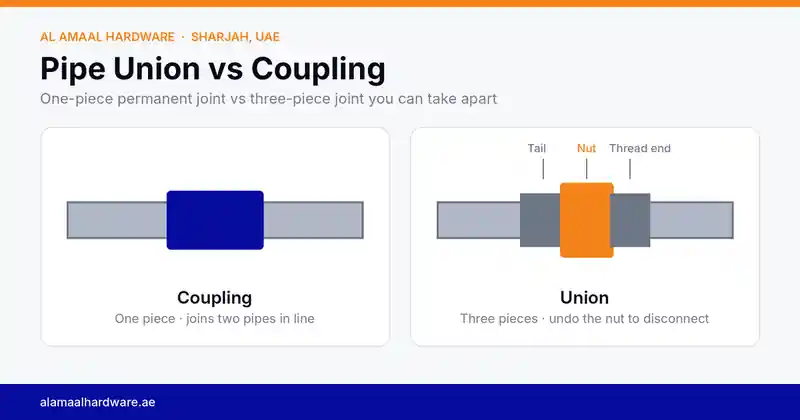
A coupling is a short, one-piece fitting that joins two pipes end to end. Threaded couplings have female threads at both ends, and socket-weld couplings have a socket at each end for the pipe to slide into before welding. In BSP terminology a threaded coupling is often called a socket.
Because a threaded coupling screws onto both pipes at once, you cannot unscrew it without turning one of the pipes. In practice that makes it a permanent or semi-permanent joint.
Types of Couplings
- Full coupling: joins two pipes of the same size in a straight line.
- Half coupling: threaded or socketed on one end only. The other end is welded to the side of a larger pipe or vessel to create a small branch, gauge or drain connection.
- Reducing coupling: has two different sizes to step a line up or down. For a fuller look at size changes, see our guide to concentric vs eccentric reducers.
- Compression and grooved couplings: mechanical couplings that clamp onto plain or grooved pipe ends. These are separate systems with their own components and are not covered in detail here.
What Is a Pipe Union?
A union is a three-piece fitting: two end pieces, one connected to each pipe, and a central nut that draws them together. Tightening the nut presses the two end pieces against each other to form a seal. Loosening it separates the joint without turning either pipe.
That is the whole point of a union: it creates a break in the line, so equipment can be taken out for repair or replacement without cutting pipe or unscrewing a whole run.
Union Seat Types
- Flat seat with gasket: two flat faces sealed by a gasket. Easy to remake, but the gasket must suit the fluid and temperature.
- Ground joint (metal to metal): a conical or spherical seat machined into the end pieces seals without a gasket. Common on malleable iron and forged steel unions and tolerant of slight misalignment.
- Brass seat: some malleable iron unions use a brass seat insert to resist corrosion at the sealing face and make the joint easier to remake.
Dielectric Unions
A dielectric union has an insulating washer and sleeve that electrically separate the two halves. It is used where copper or brass meets steel, typically at water heaters, calorifiers and some HVAC connections, to reduce galvanic corrosion between the two metals. If your system mixes metals in wet service, ask for a dielectric union rather than a standard one.
Pipe Union vs Coupling: Side-by-Side
| Feature | Coupling | Union |
| Construction | One piece | Three pieces: two ends and a nut |
| Can be disconnected? | Not without turning or cutting the pipe | Yes, by loosening the nut |
| Main purpose | Extend or repair a run | Allow removal of equipment |
| Length and bulk | Short and compact | Longer and bulkier |
| Leak paths | Two threaded or welded joints | Two pipe joints plus the seat |
| Cost | Lower | Higher |
| Typical sizes | Small bore up to larger forged sizes | Mainly small bore; flanges take over on larger lines |
When to Use a Union
- At equipment that will need removal: pumps, water heaters, meters, strainers, control valves and small coils. Fitting a union on each side lets the item lift out cleanly.
- Next to threaded valves: a union beside a ball or check valve means the valve can be replaced without dismantling the run.
- At the end of a threaded run: in a run between two fixed points, at least one union is needed to close it up, because every threaded joint cannot be tightened at once.
- Where dissimilar metals meet: use a dielectric union.
When a Coupling Is the Better Choice
- Extending a straight run where the joint will never need opening.
- Concealed or buried pipework, where fewer sealing faces and a compact joint are preferred, and where access for maintenance is not possible anyway.
- Branch and instrument connections, using a half coupling welded onto a larger pipe or vessel.
- Repairs, where a damaged section has been cut out and a new length is joined in.
Union vs Flange on Larger Lines
Unions are mainly a small-bore fitting. As line size grows, the nut becomes large and hard to tighten evenly, so larger pipework normally uses flanged joints to provide the same removable connection. Where exactly the changeover happens depends on your project specification, but on most UAE MEP and industrial jobs flanges take over from unions well before the main headers. For flange options, see our guide to types of pipe flanges.
Standards to Know
| Fitting | Common standard |
| Forged steel threaded and socket-weld couplings | ASME B16.11 |
| Malleable iron threaded couplings | ASME B16.3 or EN 10242 |
| Malleable iron threaded unions | ASME B16.39 or EN 10242 |
| Forged steel threaded and socket-weld unions | MSS SP-83 |
On threaded unions and couplings, also confirm the thread standard. Mixing NPT and BSP is a common source of leaks; our NPT vs BSP guide explains how to check. For the short connectors that usually sit between unions, valves and fittings, see our guide to pipe nipple types.
Materials
- Galvanised and malleable iron: the everyday choice for threaded plumbing, irrigation and fire lines.
- Brass: water, HVAC and gas connections where corrosion resistance and easy remaking matter.
- Carbon steel (forged): higher-pressure threaded and socket-weld lines in industrial service.
- Stainless steel 304 and 316: food, chemical, water treatment and coastal installations.
Ordering Checklist
- Fitting: union, dielectric union, full, half or reducing coupling
- Size, and both sizes for a reducing coupling
- End connection: threaded (NPT or BSP) or socket weld
- Pressure class, for example Class 150 or 300 malleable iron, or Class 3000 forged steel
- For unions: seat type (gasket, ground joint or brass seat)
- Material, finish (black or galvanised) and quantity
Common Mistakes to Avoid
- No union at serviceable equipment, so a pump or heater has to be cut out later.
- Using a standard union between copper and steel where a dielectric union is needed.
- Putting unions in concealed spaces, where the extra seal cannot be inspected or re-tightened.
- Using unions on large lines where a flanged joint would seal more reliably.
- Mixing thread standards between the union, coupling and pipe.
Frequently Asked Questions
What is the main difference between a pipe union and a coupling?
A coupling is a single piece that joins two pipes permanently. A union is three pieces with a nut, so the joint can be opened without turning or cutting the pipes.
Can I use a union instead of a coupling?
Technically yes, but it costs more, takes more space and adds a sealing face. Use unions only where you actually need to disconnect the line.
Do unions need a gasket?
Flat-seat unions do. Ground-joint unions seal metal to metal and do not need a gasket.
What is a dielectric union for?
It electrically isolates two different metals, such as copper and steel, to reduce galvanic corrosion at the joint. It is common at water heater connections.
Where should unions be placed around a pump or valve?
Usually one on each side, close to the equipment and after the isolating valves, so the item can be isolated and lifted out without draining or dismantling the rest of the system.
Sourcing Unions and Couplings in Sharjah
Al Amaal Hardware supplies unions and couplings to contractors and MEP teams across the UAE from Industrial Area 10, Sharjah. Our MI and GI threaded fittings and brass threaded fittings ranges include unions, and couplings are available in our MS threaded fittings, SS threaded fittings and brass ranges.
Send us the fitting, size, thread, class, material and quantity, and we will confirm stock and pricing. Request a quote or message us on WhatsApp for a fast response.