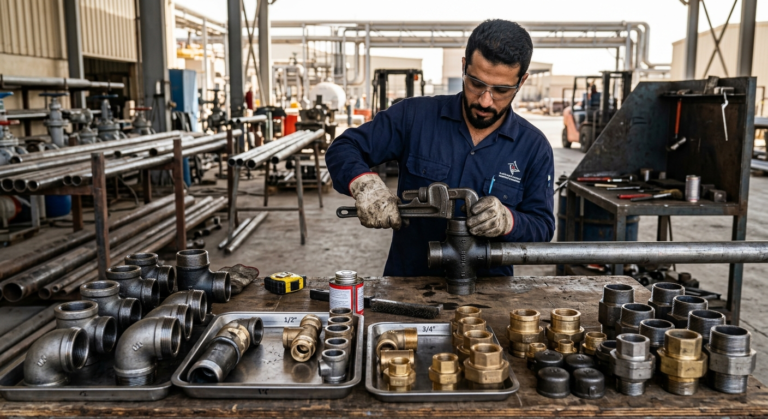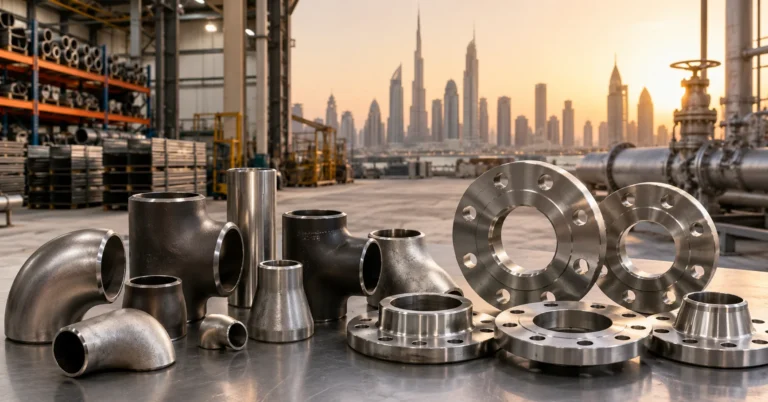
Pipe nipples are among the smallest and cheapest parts in a piping system, yet they cause a surprising share of site problems: the wrong length, the wrong thread, a wall too thin for the pressure, or a material that corrodes in a humid plant room. Understanding the main pipe nipple types and how they are specified helps you order the right part the first time.
This guide covers each common nipple type, where it is used, how length and threads are specified, which schedules and materials suit UAE conditions, and what to include in a quotation request.
What Is a Pipe Nipple?
A pipe nipple is a short length of pipe, usually threaded on both ends, used to join two female-threaded fittings or to extend a connection by a short distance. Nipples link valves, tees, elbows, unions and equipment ports in plumbing, HVAC, fire fighting, compressed air, fuel and process lines. Some types are threaded on only one end, reduce from one size to another, or have plain or bevelled ends for welding.
Common Pipe Nipple Types
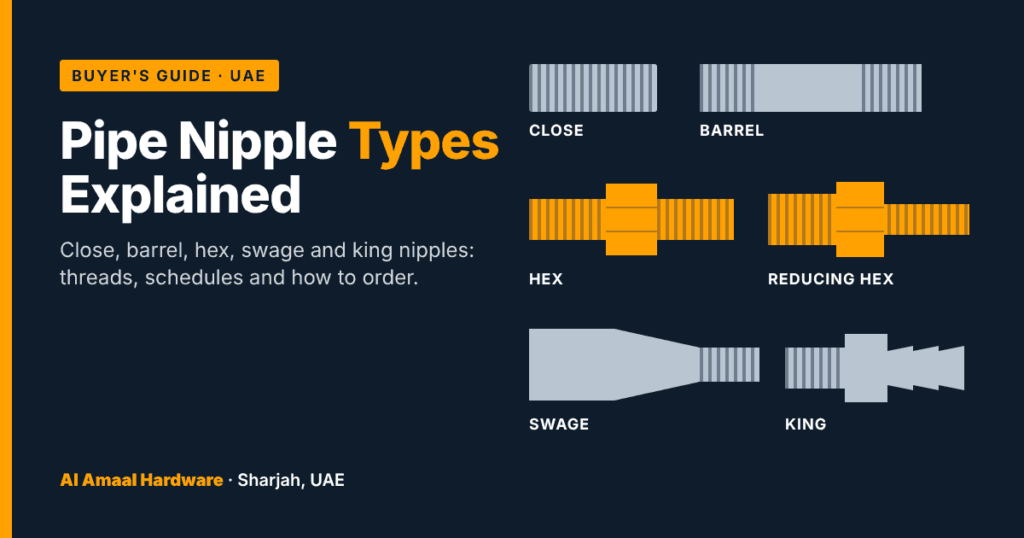
Close Nipple
A close nipple is threaded along almost its entire length, with little or no unthreaded section in the middle. It gives the shortest possible connection between two fittings, which is useful in tight valve and pump assemblies. The trade-off is that there is nowhere to grip it with a wrench, and the threads remove much of the wall, so it is the weakest nipple for a given schedule.
Shoulder Nipple
A shoulder nipple is slightly longer than a close nipple, leaving a short unthreaded band in the middle. It is still compact, but the small shoulder keeps the two fittings from bottoming out against each other.
Barrel (Long) Nipple
A barrel nipple has threads on both ends and a plain, unthreaded section in the middle. It is the most common general-purpose nipple, available in a wide range of lengths, and is used to extend a pipe run or space out fittings. Because the centre keeps full wall thickness, it is stronger than a close nipple of the same schedule.
TOE Nipple (Threaded One End)
A TOE nipple is threaded on one end only; the other end is plain or bevelled. It is used to move from a threaded connection to a welded or slip-on connection, and for vents, drains and tank connections.
Hex Nipple
A hex nipple has a hexagonal section in the middle and male threads on both sides. The hex lets you tighten it with a spanner, which is why hex nipples are popular in brass and stainless steel for plumbing, instrumentation, pneumatics and hydraulic connections. Hex nipples are commonly machined from bar stock rather than cut from pipe.
Reducing Hex Nipple
A reducing hex nipple has a different thread size on each side of the hex, for example 1/2″ x 1/4″. It changes size and joins two female fittings in a single part, making it a compact alternative to a bushing plus a nipple.
Swage Nipple
A swage nipple is a tapered reducing nipple that joins two different pipe sizes, typically on higher-pressure small-bore lines in oil and gas, petrochemical and process piping. It comes in concentric and eccentric versions, and each end can be plain, bevelled or threaded. Swage nipples work much like reducers; our guide to concentric vs eccentric reducers explains when to use each shape.
King Nipple (Hose or Combination Nipple)
A king nipple has a male thread on one end and a serrated hose shank on the other, often with a hex in between. It connects a threaded pipe, valve or pump outlet to a flexible hose, and is widely used for suction and discharge hoses on water transfer, fuel, chemical and marine applications.
Welding Nipple
A welding nipple has plain or bevelled ends instead of threads, for socket-weld or butt-weld connections. It is chosen where vibration, temperature swings or pressure make a threaded joint unsuitable.
Pipe Nipple Types at a Glance
| Type | Ends | Typical use |
| Close | Threaded both ends, almost no gap | Shortest joint in tight assemblies |
| Shoulder | Threaded both ends, short plain band | Compact joints with a small spacer |
| Barrel | Threaded both ends, plain centre | General extensions and spacing |
| TOE | Threaded one end, plain or bevelled other | Threaded-to-welded transitions, vents, drains |
| Hex | Male threads both sides of a hex | Plumbing, instruments, pneumatics |
| Reducing hex | Different thread sizes either side | Size change between two female ports |
| Swage | Plain, bevelled or threaded; tapered body | Size change on higher-pressure lines |
| King (hose) | Thread one end, hose shank the other | Pipe or pump to hose connections |
| Welding | Plain or bevelled both ends | Socket-weld or butt-weld systems |
How Nipple Length Is Measured
Nipple length is the overall end-to-end length, including the threads, not the visible gap once installed. For a close nipple, the length is set by the thread lengths for that size, so it changes from one pipe size to the next. When you need a specific installed spacing between fittings, allow for the thread engagement in each fitting and order the overall length accordingly.
Thread Types: NPT, BSPT and BSPP
UAE sites use both American and British thread standards, often on the same project:
- NPT: tapered, 60-degree thread, common on US-specification valves and equipment. It seals on the thread with tape or sealant.
- BSPT: tapered, 55-degree British thread, widely used on European and local-specification projects. It also seals on the thread.
- BSPP: parallel British thread that does not seal on the thread itself; it relies on a sealing washer, bonded seal or O-ring.
NPT and BSP nipples can look almost identical but will not seal reliably together. Read our NPT vs BSP guide for identification tips, and our guide to threaded pipe fittings in the UAE for the fittings nipples connect to.
Schedules and Pressure
Threading cuts into the pipe wall, so a threaded nipple is weaker than plain pipe of the same schedule. That is why the schedule matters more for nipples than many buyers expect:
- Schedule 40 (standard weight): common for water, HVAC and general low-to-medium pressure service.
- Schedule 80 (extra strong): preferred for higher pressure, vibration and threaded process connections, because more wall remains after threading.
- Schedule 160 and XXS: used for high-pressure small-bore connections, and often specified for swage nipples.
Welded and seamless carbon steel and austenitic stainless steel nipples are covered by ASTM A733. Always check the pressure and temperature rating against your design conditions; our article on choosing pipe fittings for high-pressure applications goes deeper.
Choosing the Material
- Mild (carbon) steel: strong and economical for fire fighting, industrial and black steel systems.
- Galvanised steel (GI): zinc-coated for general water and utility lines; the threads are the most exposed area, so seal them well.
- Stainless steel 304 and 316: chosen for desalination, chemical, pharmaceutical, food and coastal installations. 316 is generally the better choice where chlorides or salt air are present.
- Brass: common for hex nipples in plumbing, water heaters, gas and instrument connections.
Match the nipple material to the fittings it joins; pairing dissimilar metals in wet service can cause galvanic corrosion. If galling is a concern on stainless threads, use an anti-seize compound rated for stainless steel.
How to Order Pipe Nipples
Include these details in your enquiry:
- Type: close, barrel, TOE, hex, reducing hex, swage, king or welding
- Nominal size, plus the second size for reducing types
- Overall length (for barrel and TOE nipples)
- Schedule or pressure class
- Thread standard: NPT, BSPT or BSPP, or end type for welding nipples
- Material and grade
- Quantity and any certificates required
Common Mistakes to Avoid
- Ordering by installed gap instead of overall length, which leaves the nipple too short.
- Using a Schedule 40 close nipple on a high-pressure or vibrating line, where the thin threaded wall is the weak point.
- Mixing NPT and BSP nipples and fittings.
- Combining a bushing and a nipple when a single reducing hex nipple or swage nipple would do the job with one fewer joint.
- Choosing GI or mild steel for coastal or chemical service where stainless steel is needed.
Frequently Asked Questions
What is the difference between a close nipple and a barrel nipple?
A close nipple is threaded almost its full length for the shortest possible joint, while a barrel nipple has a plain section between the threaded ends and comes in longer lengths.
What is a hex nipple used for?
A hex nipple joins two female-threaded fittings and has a hex in the middle so it can be tightened with a spanner. It is common in plumbing, instrument and pneumatic connections.
How is pipe nipple length measured?
By overall length from end to end, including the threads.
What is the difference between a swage nipple and a reducing hex nipple?
Both change size. A swage nipple has a tapered body and can have plain, bevelled or threaded ends, and is typically used on higher-pressure lines. A reducing hex nipple is a compact threaded part with a hex, used mainly on smaller threaded connections.
What is a king nipple?
A king nipple, also called a hose or combination nipple, has a male thread on one end and a serrated hose shank on the other, to connect threaded pipework to a flexible hose.
Sourcing Pipe Nipples in Sharjah
Al Amaal Hardware supplies pipe nipples to contractors and MEP teams across the UAE from Sharjah. Our range includes MS barrel nipples from 1/4″ to 6″, SS pipe nipples from 1/8″ to 6″, MS swage nipples and SS swage nipples in concentric and eccentric types from 1/4″ to 8″, and SS king nipples (hose nipples) from 1/2″ to 12″. Hex nipples are part of our SS threaded fittings and brass threaded fittings ranges.
Send us the type, size, length, schedule, thread and quantity, and we will confirm availability and pricing. Request a quote or message us on WhatsApp for a fast response.