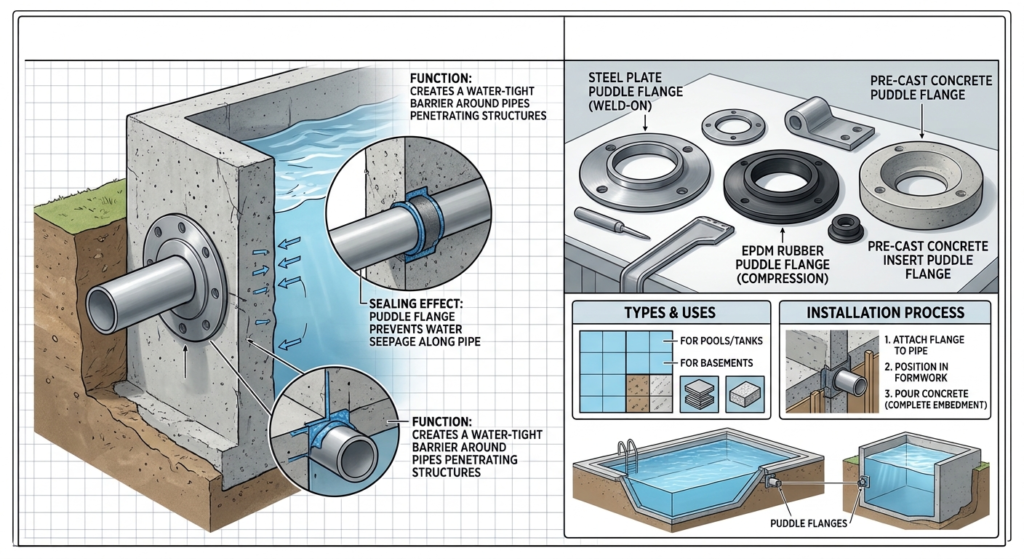
A puddle flange is a collar or plate fixed around a pipe where it passes through a concrete wall or slab. It is cast into the concrete and acts as a water stop: it blocks water from seeping along the outside of the pipe, which is the weakest point of any pipe penetration. Puddle flanges are used in water tanks, sewage treatment plants, swimming pools, basements, pump pits and manholes.
Concrete doesn’t bond to a pipe’s smooth outer surface, and concrete shrinks slightly as it cures. That leaves a hairline gap around the pipe where water under pressure will find its way through. In the UAE, that matters most in underground and rooftop water tanks, basements in coastal areas, and sewage and irrigation structures. A puddle flange fitted before the pour solves the problem at almost no cost compared with repairing a leaking tank wall later.
How a Puddle Flange Works
Water moving along the pipe surface meets the flange and has to travel out to its edge, around it and back again before it can continue. That longer, more difficult path, embedded in solid concrete, stops seepage. Engineering guidance on water-retaining concrete structures, such as BS 8007 and its replacement BS EN 1992-3, treats pipe penetrations as a critical detail for exactly this reason.
A puddle flange is sometimes called a wall flange, water stop flange, puddle collar or, in the US, a wall collar. When the flange is part of a short length of pipe made for the purpose, the whole assembly is often called a puddle pipe.
Types of Puddle Flange
| Type | How it’s made | Typical use |
|---|---|---|
| Welded steel puddle flange | A steel plate or ring welded around the pipe | Steel pipe through tank walls, pump rooms, plant rooms |
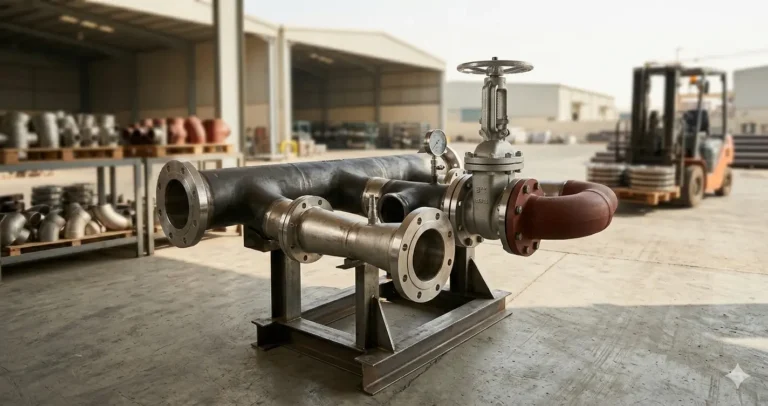
| Double-flanged puddle pipe | A short spool with a flange at each end and a welded puddle plate in the middle | Tank inlets, outlets and drains where valves bolt on both sides |
| Flanged × plain-end puddle pipe | Flange on one end, plain or bevelled on the other | Where one side is welded or connected with a coupling |
| Rubber (EPDM) clamp-on puddle flange | A flexible rubber collar clamped onto the pipe with stainless steel bands | Plastic or mixed pipe materials, drainage, smaller sizes |
| PVC/uPVC puddle flange | A plastic collar solvent-welded to the pipe | uPVC drainage and waste lines |
For water tanks and pump rooms, the double-flanged puddle pipe is the most common choice because valves, strainers and flexible connectors can bolt directly to it on both sides of the wall.
Puddle Flange Materials
- Mild steel (MS), galvanized or epoxy-coated: economical for general water and fire water tanks. The coating protects the steel inside the concrete and where it is exposed.
- Stainless steel (SS304 or SS316): for potable water tanks, treated sewage effluent, desalinated water and coastal sites. SS316 offers better resistance where chlorides are present.
- Ductile iron: used on larger municipal water and sewage mains.
- EPDM rubber with SS clamps, or uPVC: for plastic pipe systems.
Match the puddle flange material to the pipe, the water quality and the environment. Mixing metals, such as a carbon steel puddle pipe connected directly to stainless valves, can cause galvanic corrosion unless the joint is isolated.
Where Puddle Flanges Are Used
- Underground and rooftop water tanks: inlets, outlets, overflows, drains and pump suction lines
- Sewage treatment plants (STPs) and lift stations
- Swimming pools and water features: return and suction lines through the shell
- Basements and retaining walls, especially where groundwater is high
- Pump pits, valve chambers and manholes
- Firewater tanks: suction connections to fire pumps
How to Install a Puddle Flange
- Confirm the position on the drawings before the formwork is closed: centre line, level and wall thickness.
- Fit the puddle pipe in the formwork and fix it so it can’t move during the pour. A puddle flange is not a structural anchor, so support the pipe independently.
- Centre the flange in the wall thickness. This gives equal concrete cover on both sides.
- Allow enough concrete cover around the flange. Rubber puddle flange manufacturers such as Fernco and Flexseal call for at least about 50 mm of concrete around every surface of the flange.
- Clean the flange and pipe of oil, loose rust and mill scale before the pour so the concrete contacts it fully.
- Vibrate carefully around the penetration to remove air pockets without knocking the pipe out of position.
- Protect flange faces and threads until the valves and pipework are connected.
- Test the tank or structure for watertightness before backfilling or finishing.
Note that rubber clamp-on puddle flanges do not provide axial restraint. If the pipe will carry thrust, use a welded steel puddle flange or a designed thrust collar instead.
How to Size a Puddle Flange
The flange must project far enough from the pipe to lengthen the seepage path, but still leave enough concrete cover in the wall. As a guide, Fernco’s fitted puddle flanges have an outside diameter roughly 100 mm (4 inches) larger than the pipe they fit. For welded steel puddle plates, the plate diameter and thickness are normally set by the project’s structural or MEP drawings, so always follow the specified detail.
How to Order a Puddle Flange or Puddle Pipe
Send us:
- Pipe size (NPS or DN) and schedule or wall thickness
- Wall or slab thickness, which sets the overall length of the puddle pipe
- End connections: flanged both ends, flanged × plain, or threaded, plus the flange standard and rating (e.g. ASME B16.5 Class 150 or EN 1092-1 PN16)
- Puddle plate size and thickness, if specified
- Material and finish: MS galvanized, MS epoxy-coated, SS304 or SS316
- Quantity, any drawings, and whether you need test certificates
Not sure which flange drilling you need? Check our flange size chart for ASME B16.5 and PN16 first.
Planning a tank, STP or pump room? Send us your drawing or specification on WhatsApp at +971 52 684 9954 or request a quote. We supply MS flanges, SS flanges and the valves, strainers and flexible connectors that bolt onto puddle pipes, from our store in Industrial Area 10, Sharjah.
Related guides: types of pipe flanges, blind flanges, the pump flexible connector guide and Y strainers.
Frequently Asked Questions
What is a puddle flange used for? It stops water seeping along the outside of a pipe where the pipe passes through a concrete wall or slab, such as a water tank or basement wall.
Is a puddle flange the same as a wall flange? Yes. Puddle flange, wall flange, water stop flange and puddle collar all describe the same fitting.
Where should a puddle flange be positioned? In the centre of the wall or slab thickness, with enough concrete cover around it on every side.
Can I add a puddle flange after the concrete is poured? Not as a cast-in water stop. For existing walls, a core-drilled hole with a mechanical link seal or a sealed sleeve is the usual alternative.
What is a double flanged puddle pipe? A short pipe spool with a flange at each end and a puddle plate welded in the middle, cast into a tank wall so valves and pipes can bolt on either side.
About Al Amaal Hardware
This guide was prepared by the sales and technical team at Al Amaal Hardware, a supplier of pipe fittings, flanges and valves in Industrial Area 10, Sharjah, serving contractors, MEP firms and maintenance teams across the UAE.
Always follow the project’s structural and MEP drawings for puddle flange size, position and material.
Related Guides and Products
- Types of pipe flanges explained — weld neck, slip-on, blind and threaded, and where each belongs
- Flange size chart — ASME B16.5 Class 150 and PN16 dimensions, and how to measure a flange
- Pipe schedule chart — wall thickness for the pipe passing through the penetration
- MS flanges and SS flanges — carbon and stainless flanges stocked in Sharjah
- Request a quote — send your sizes and we will confirm availability