Pumps, chillers, cooling towers and air handling units all vibrate. If that equipment is bolted rigidly to the pipework, vibration and noise travel along the pipes into the building structure, and every start, stop and temperature swing puts strain on flanges, nozzles and supports. A pump flexible connector breaks that rigid link. Fitted correctly, it absorbs vibration, reduces noise and takes up small pipe movements. Fitted badly, it can fail early or even pull apart under pressure.
This guide covers how to choose the right connector for pumps and chillers, how to install it, and the mistakes we see most often on UAE MEP projects.
What Does a Flexible Connector Do?
A flexible connector is a short, flexible section installed between equipment and the connecting pipe. On pump and chiller connections it has three jobs:
- Vibration isolation: stops mechanical vibration from the motor and impeller travelling into the pipework.
- Noise reduction: the flexible body dampens structure-borne noise, which matters in hotels, hospitals, offices and residential towers.
- Movement absorption: takes up small axial, lateral and angular movements from thermal expansion and equipment movement on its isolation mounts.
It is not designed to correct badly aligned pipework. That point comes up again below because it is the most common cause of failure.
Types of Flexible Connectors
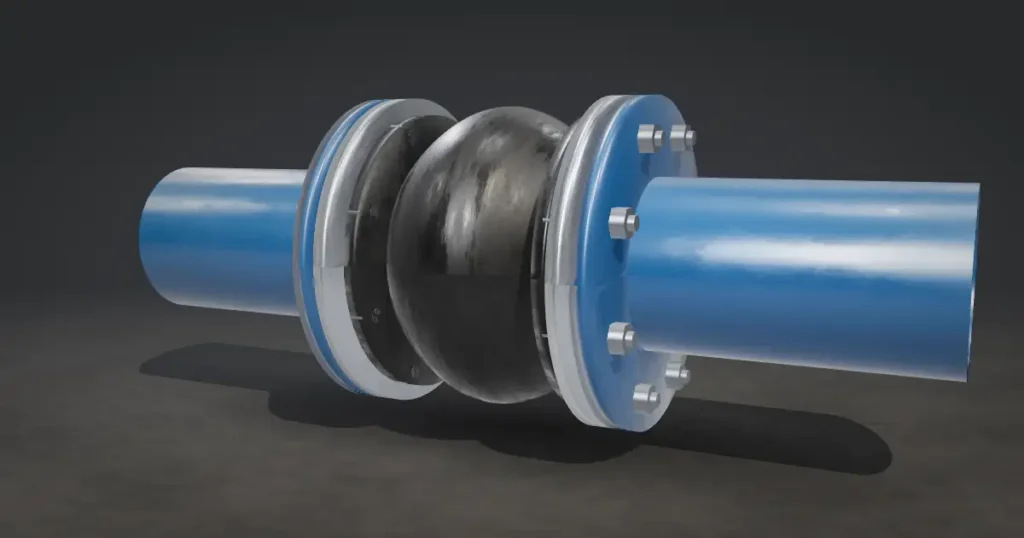
Single Sphere Rubber Connector
The most common type on HVAC and pump connections. A single moulded arch of elastomer, reinforced with fabric or wire, sits between two flanges. It is compact and gives good vibration and noise isolation for its length. This is the familiar rubber expansion joint you see on chilled water and condenser water pump sets.
Twin (Double) Sphere Rubber Connector
Two arches in one body. It is longer than a single sphere unit and accepts more movement, particularly lateral offset, so it is used where larger movements or better isolation are needed.
Braided Metal Hose Connector
A corrugated stainless steel hose with a braided outer cover. It suits higher temperatures and services where rubber is not suitable, but it absorbs less axial movement and generally isolates noise less effectively than a rubber sphere. It is common on gas, steam and some fire fighting and hot water connections.
How to Choose the Right Connector
| Check | What to confirm |
| Size | Match the pipe or equipment flange size, not the pump nozzle if a reducer is used |
| Pressure | Working and test pressure of the system, including pump shut-off head |
| Temperature | Maximum fluid temperature; chilled water and condenser water are well within rubber limits, hot water needs checking |
| Fluid | Water, glycol mix, oil or chemical, which decides the rubber grade |
| Movement | Expected axial, lateral and angular movement |
| End connection | Flange drilling (for example PN16 or ANSI 150) to match the mating flanges, or threaded union ends on small sizes |
| Location | Indoor plant room, or rooftop with sun exposure |
Rubber Grade
The elastomer must suit the fluid. EPDM is widely used for water, chilled water and glycol systems. Nitrile (NBR) is used where oils are present. Neoprene is a general-purpose option with reasonable weather resistance. Always check the manufacturer’s compatibility data for anything other than plain water.
Control Rods: Why They Matter
Internal pressure tries to push the two ends of a rubber connector apart. If the pipe on either side is not properly anchored, the connector can stretch beyond its limit and fail. Control rods (also called tie rods or limit rods) link the two flanges and stop over-extension.
Control rods are generally recommended when the piping is not anchored on both sides of the connector, when the equipment sits on spring isolators, or when system pressure is high relative to the connector rating. Note that fully tightened rods also limit the connector’s ability to absorb axial compression, so follow the manufacturer’s setting instructions.
Where to Install on a Pump Set
A typical end-suction or split-case pump arrangement on a chilled water system includes, in flow order on the suction side: isolation valve, strainer, flexible connector, then the pump. On the discharge side: flexible connector, check valve, isolation valve. The connector should be as close to the equipment as practical, so it isolates vibration before it reaches the rest of the pipework.
Where the suction line is larger than the pump inlet, the reducer usually sits between the connector and the pump. Our guide to concentric vs eccentric reducers explains which one belongs at a pump suction. For strainer selection, see our Y-strainer guide.
Installation Checklist
- Support the pipe, not the connector. Pipework on both sides should be independently supported and anchored so the connector carries no pipe weight.
- Align the flanges first. Install at the specified face-to-face length with the flanges parallel and on the same centreline.
- Check the gasket requirement. Many rubber connectors have a moulded rubber flange face that acts as the seal. Follow the manufacturer’s instructions on whether an extra gasket is needed.
- Tighten bolts evenly. Work in a cross pattern and do not over-tighten, which can damage the rubber flange face.
- Fit control rods where required and set them to the manufacturer’s instructions.
- Do not paint or insulate tightly over the rubber body. Paint solvents can attack the elastomer, and rigid insulation restricts movement.
- Keep welding away. Complete any welding near the connector before it is installed, or shield it from heat and spatter.
Common Mistakes on UAE Projects
- Using the connector to fix misalignment. Forcing a connector to bridge an offset or gap uses up its movement capacity before the system even starts, and leads to early cracking.
- No anchors and no control rods. The connector stretches under pressure and can separate from the flanges.
- Rooftop units left in direct sun. UV and high surface temperatures age rubber faster. Shade or cover connectors on exposed rooftop chillers and cooling towers, and include them in routine inspections.
- Wrong rubber for the fluid. Oil or chemical contamination can swell or soften the wrong elastomer.
- Ignoring pump shut-off pressure. Size the pressure rating for the highest pressure the connector will see, not just normal running pressure.
Inspection and Replacement
Check rubber connectors during planned maintenance. Replace a connector if you see surface cracks that expose the reinforcement, blistering, bulging, permanent deformation, or leaks at the flange face. Isolate and drain the section before removing a connector, and replace like for like in size, rating and face-to-face length.
Frequently Asked Questions
Is a flexible connector the same as a rubber expansion joint?
On pump and HVAC connections the terms are often used for the same product: a flanged rubber sphere joint. “Flexible connector” is the broader term and also covers braided metal hoses.
Do I need flexible connectors on both suction and discharge?
Usually yes. Fitting one on each side of the pump isolates vibration in both directions and is the common practice on HVAC pump sets. Follow the project specification.
Can a flexible connector be installed vertically?
Yes, rubber connectors can be fitted in vertical or horizontal lines, provided the pipe on both sides is properly supported and the connector does not carry pipe weight.
How long does a rubber flexible connector last?
Service life depends on pressure, temperature, fluid, movement and sun exposure. Regular inspection is the reliable way to decide when to replace one.
Flexible Connectors from Al Amaal Hardware
We supply flexible connectors (rubber expansion joints) from 1″ to 24″ for HVAC, plumbing and pumping systems across the UAE, from our base in Sharjah.
Send us the size, flange drilling, working pressure, fluid and quantity, and we will confirm the right connector and price. Request a quote or message us on WhatsApp for a fast response.